Client Not Responding After a Quote? What to Do Next
Your client went quiet after the quote? The 6 most common reasons, the right message for each one, and when to close the file.
 Julien DevoirCo-founder, Product & Systems

On this page
The appointment went well. The client asked questions, took notes, even said: "We'll get back to you soon." You sent the quote the next day. Since then, nothing. No refusal, no question. Silence.
The temptation is to give up ("they weren't serious"). Or to send the same follow-up again and again, hoping the next one gets through.
There's a better approach: figure out what the silence is hiding, and send the message that answers it. Here are the six most common reasons, the right message for each, and when it's better to close the file.
Silence isn't a no
A client who means no rarely says so. It's uncomfortable and invites explanations, so they let it slide. But a client who hasn't replied hasn't necessarily said no. Very often, they simply haven't decided yet, and nothing is helping them decide.
Silence is a waiting state. Your job is to work out what the client is waiting for.
6 reasons a client stops responding
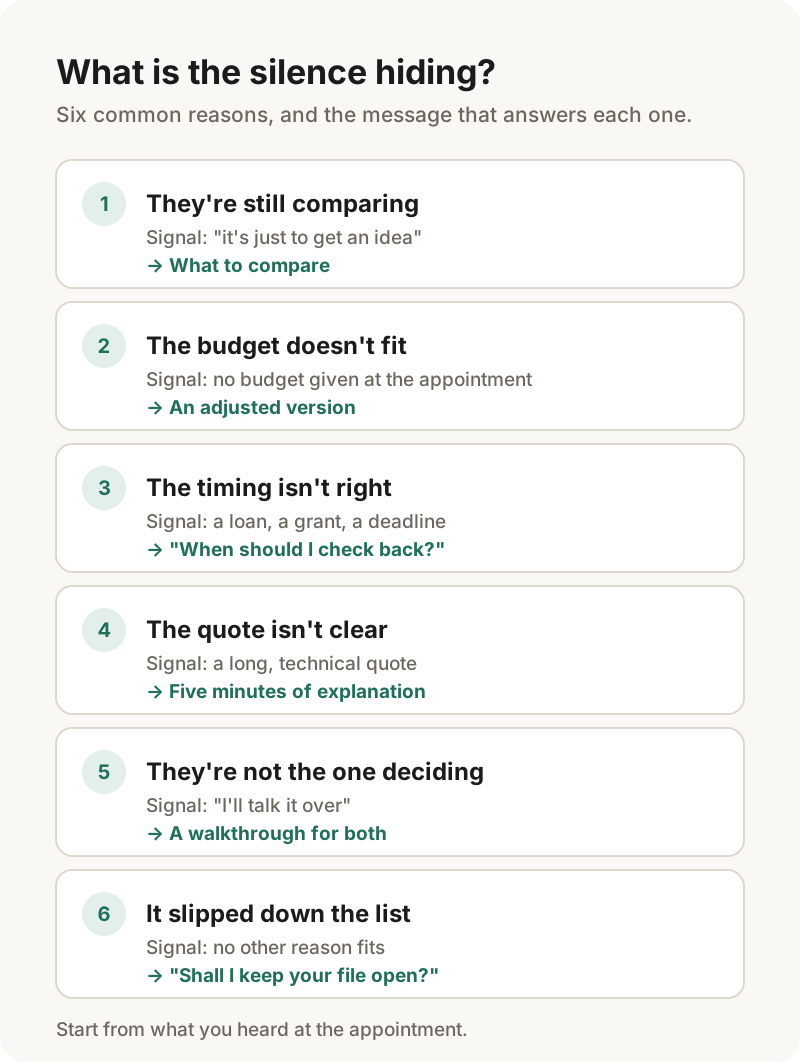
1. They're still comparing
They're waiting for other quotes and don't want to answer anyone until they have them all. Common on bigger projects.
The signal: they mentioned other companies at the appointment, or asked for your quote "to get an idea".
What they're waiting for: a way to compare fairly. A competitor who looks cheaper on paper may not include the same things you do.
2. The budget doesn't fit
The total is higher than they expected, and they don't want to say so. Sometimes they don't know how to negotiate, or feel awkward scaling the project down.
The signal: they wouldn't give a budget at the appointment, or reacted when price came up.
What they're waiting for: an option that fits their budget, without having to ask for it.
3. The timing isn't right
The project is still on, but they're waiting for something: a loan, a rebate, a property sale, the end of the holidays, another job.
The signal: they mentioned financing, a pending application or a deadline.
What they're waiting for: for you to still be there when they're ready.
4. The quote isn't clear
A line worries them, a technical term means nothing to them, an option makes them hesitate. They don't want to "bother you" with a question they think is silly.
The signal: the quote is long and technical, or they were rushed at the appointment.
What they're waiting for: a simple explanation, without having to ask.
5. They're not the one deciding
The person you met isn't the only decision-maker. A spouse, business partner, landlord or parent is paying for or signing off on the project.
The signal: only one person was at the appointment, and they said "I'll talk it over".
What they're waiting for: something to convince the other person with, or a moment where you can present the project to both of them.
6. The project slipped down the list
Life got in the way: an unexpected expense, a change of plans, something more urgent. The project isn't dead, it's just lower on the list.
The signal: none in particular. It's often the reason when nothing else fits.
What they're waiting for: nothing specific. But a well-timed reminder can bring the project back up.
The right message for each reason
You won't always know which reason applies. Start from what you heard at the appointment, and pick the matching message.
They're still comparing
Hi [First name], if you're comparing a few quotes for [project], I can help you check that each one includes the same things: [often-missed item, e.g. waste removal or the warranty]. Would a short checklist of what to compare be useful?
The budget doesn't fit
Hi [First name], I wondered whether the quote for [project] matched what you'd planned to spend. If not, I can put together a version [in two phases / with different materials / without a given option]. Shall I prepare it?
The timing isn't right
Hi [First name], I know [project] depends on [your financing / your rebate / your schedule]. No rush at all. Roughly when would you like me to check back in?
The quote isn't clear
Hi [First name], the quote for [project] has a few technical terms in it. If any line seems unclear, I can talk you through it in five minutes by phone, or send a short summary version. Which would you prefer?
They're not the one deciding
Hi [First name], if [your partner / your business partner] has questions about [project], I'm happy to walk you both through it. I'm free [day] after work, or by phone if that's easier.
The project slipped down the list
Hi [First name], getting back to you about [project]. I completely understand if other things have come first. Shall I keep your file open, or would you rather I close it for now?
The multiple-choice message, when you can't tell
When no reason stands out, ask, but make it effortless. The multiple-choice message works because the client only has to reply with a letter.
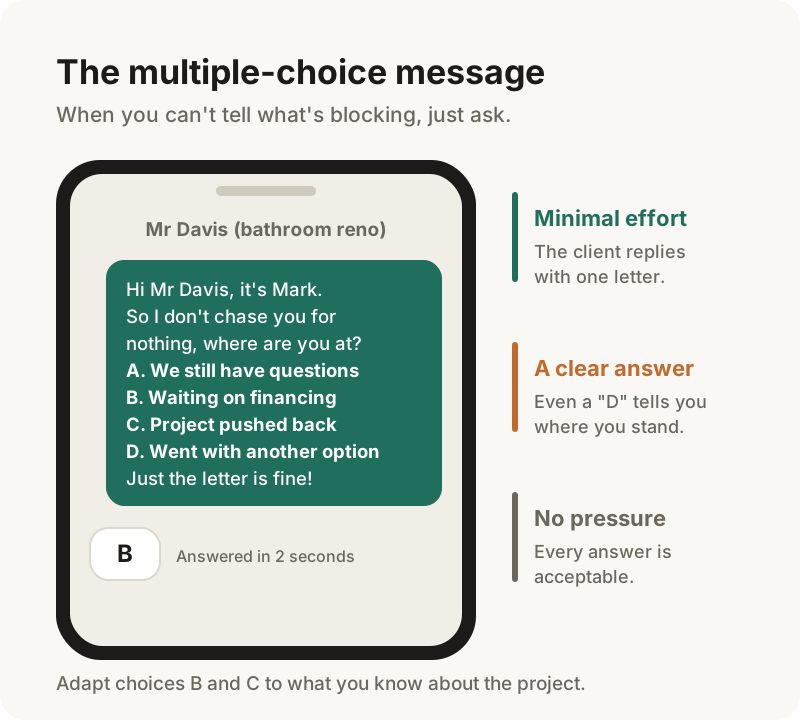
Hi [First name], it's [Your name] from [Company]. So I don't chase you for nothing about [project], where are you at?
A. We still have questions B. We're waiting on [financing / other quotes] C. The project's been pushed back D. We went with another option
Just reply with the letter, that's all I need.
It has two advantages. The client doesn't have to write anything, and you get a clear answer, even when it's D.
When they don't pick up: switch channels
If your messages go unanswered, don't keep using the same channel. Switch.
- You emailed? It may be sitting in spam. Send a text.
- You texted? Call, at a different time: early evening rather than midday.
- You called with no answer? Leave a short voicemail, then back it up with a text: "Just left you a voicemail about [project]."
Vary the timing too. A client who works days won't answer at 10am, but might at 6:30pm or on Saturday morning.
When should you stop following up?
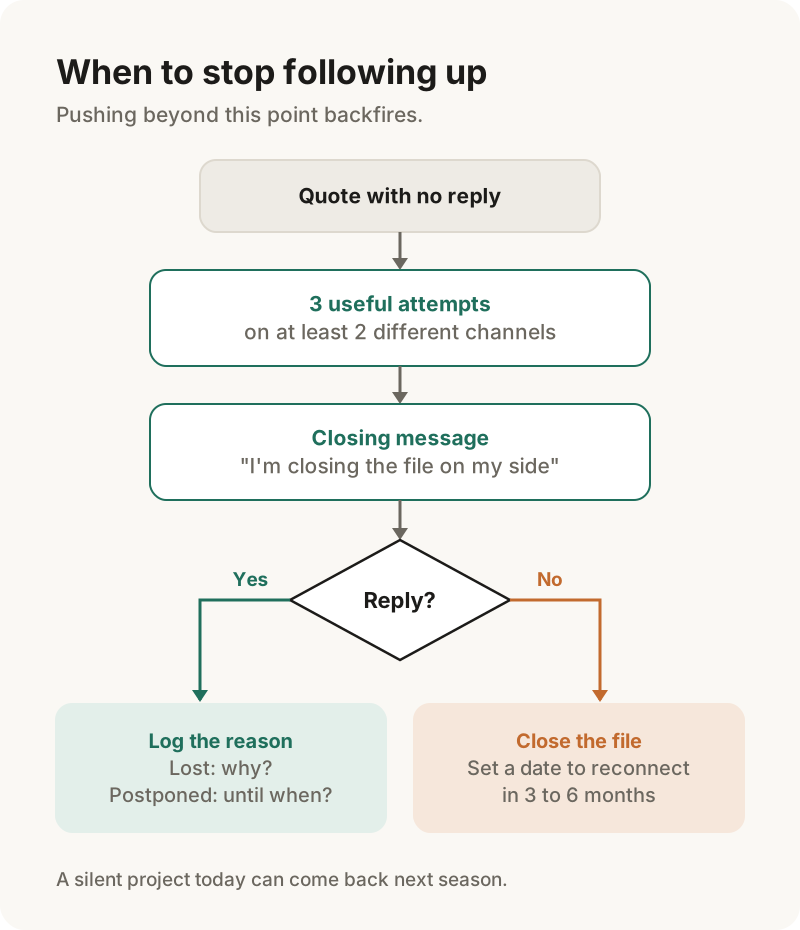
There's a point where pushing becomes counterproductive. A good rule: three useful attempts, on at least two different channels. Useful means each one brings something new.
After those three attempts, send a closing message:
Hi [First name], I don't want to keep chasing you, so I'm closing the [project] file on my side. If the project comes back around, you know where to find me. And if you went with another option, a one-line reason would really help me.
This message often gets a reply, precisely because it stops asking for anything.
Then, two cases:
- The client replies: note the reason, even if it's a no. And if the project's been pushed back, note the date they give.
- Still no reply: close the file, but note a date to get back in touch in three to six months. A silent project today can come back next season.
Preventing the silence next time
The best way to handle silence is to avoid it. Three habits cut down unanswered quotes a lot:
- Agree the next step at the appointment. Before you leave, set the date you'll call: "I'll send the quote Thursday and call you next Tuesday to go through it." The client knows you'll be back, and gets their questions ready.
- Ask who decides. "Are you deciding on your own, or does someone else need to see the project?" If someone else decides, offer to present it to them too.
- Talk budget before you price. A range, even a rough one, stops you sending an out-of-budget quote that will never get an answer.
From the handbook: After the quote: get a clear decision, not silence, how to agree the next step and close quotes without closing the relationship.
Key points
- A client who stopped responding hasn't necessarily said no: they're comparing, hesitating, waiting, or not the only one deciding.
- Match your message to the likely reason for the silence. If you can't tell, ask with a multiple-choice message.
- After three useful attempts, close the file politely and note a date to reconnect.
Frequently asked questions
How long should you wait before following up with a client who went quiet?
A week without news after sending the quote justifies a first follow-up, unless the client gave you a date. For projects decided over several months, space your follow-ups further apart, but don't let the silence settle without any contact at all.
How do you follow up with an unresponsive client without being pushy?
Bring something new in every message: an answer, an option, a date. Ask an easy question, such as a choice between a few short answers, and always give the client an easy way to say the project is on hold.
When should you stop following up on a quote?
After three useful attempts on different channels, send a closing message that leaves the door open. Then note a date to get back in touch in a few months, unless the project was clearly dropped.
Read next: How to Follow Up on a Quote Without Being Pushy (+ 5 Templates)