How to Follow Up on a Quote Without Being Pushy (+ 5 Templates)
Follow up on a quote without sounding pushy: when to do it, which channel to use, what to say, and 5 ready-to-copy follow-up messages.
 Julien DevoirCo-founder, Product & Systems
On this page
- Why an unanswered quote isn't a no
- When to follow up on a quote: a simple schedule
- Call, text or email: which channel when?
- What makes a follow-up useful instead of pushy
- 5 quote follow-up templates you can copy
- What happens after the last follow-up?
- Keeping on top of follow-ups without losing your evenings
- Key points
- Frequently asked questions
You sent the quote on Tuesday. At the appointment, the customer seemed keen. Ten days later: nothing. You think about calling, but you don't want to come across as the pushy salesperson. So you tell yourself: "If they're interested, they'll come back."
Sometimes they do. More often, they're waiting for someone to make the next step easy.
Following up on a quote isn't pressure. It's finishing the job you started at the first visit. Here's when to follow up, which channel to use, what to say, and five messages you can copy as they are.
Why an unanswered quote isn't a no
A customer who hasn't replied hasn't necessarily said no. Behind the silence, there's almost always one of these:
- They're comparing. They're waiting for other quotes and don't want to answer before they have them all.
- They have a question. A line isn't clear or an option bothers them, but it feels too small to call about.
- They're waiting on something. A loan, a rebate, a partner's approval, another job finishing.
- They need to talk it over. The spouse, business partner or landlord wasn't at the appointment.
- They forgot. Life got busy, and your email slid under fifty others.
- They never saw it. It went to spam, or the attachment won't open on their phone.
None of these sorts itself out while you wait. Each one gets solved by a follow-up that brings the right answer.
When to follow up on a quote: a simple schedule
The rule is simple: every follow-up needs a reason. Not "just checking in", but "making sure it arrived", "answering your question", "offering you a date".
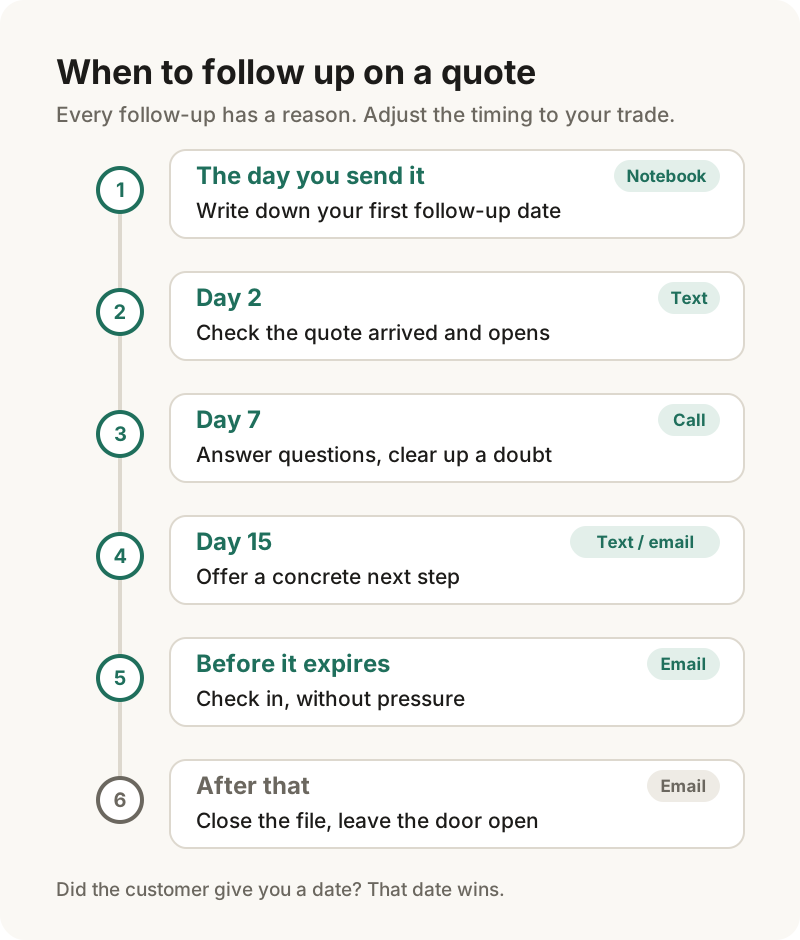
Here's a rhythm that works for most quotes:
- The day you send it: write down the date of your first follow-up right away. That's what stops you from forgetting.
- Two days later: a short text to check the quote arrived and opens properly.
- One week later: a call to answer questions. This is often where the project gets unstuck.
- Two weeks later: offer a concrete next step: a slot, a visit, a sample, an adjusted version.
- A few days before the quote expires: check in, with a genuine reason to get in touch.
- After that: close the file politely, with a message that leaves the door open.
Adjust it to your trade. A small repair gets followed up faster than a renovation that's decided over several months. And if the customer gave you a date ("we'll decide after the holidays"), that date beats any standard schedule.
Call, text or email: which channel when?
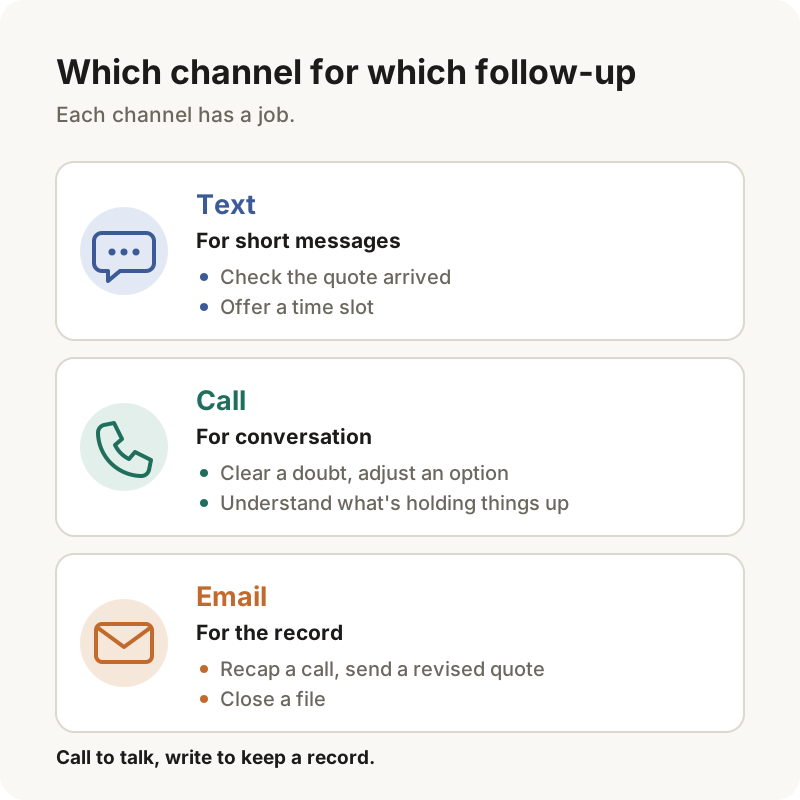
Each channel has a job:
- Text is for short messages: checking the quote arrived, offering a slot, confirming an appointment. It gets read quickly, usually the same day.
- A call is for conversation: clearing a doubt, understanding a hesitation, adjusting an option. For a bigger project, nothing beats your voice.
- Email is for the record: recapping what you said on the phone, sending a revised quote, closing a file.
A simple rule: call to talk, write to keep a record. If they don't pick up, leave a short voicemail and back it up with a text.
What makes a follow-up useful instead of pushy
A pushy follow-up asks the customer for something. A useful one gives them something. In practice, a good message has four parts.
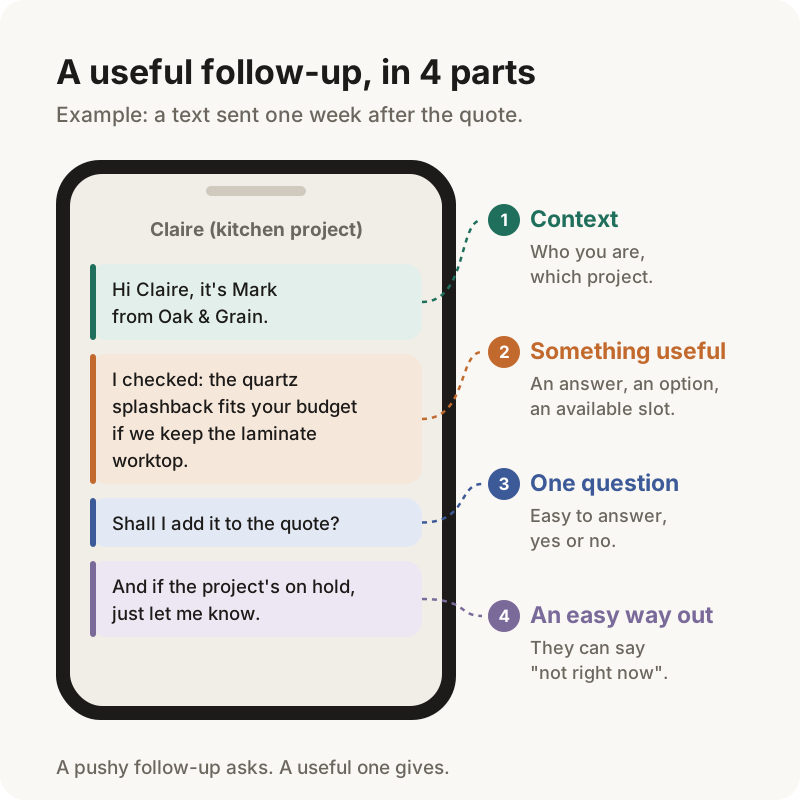
- Context: who you are and which project this is. They may have received three quotes this week.
- Something useful: an answer, a piece of information, an option, an available slot. That's the reason for your message.
- One question, easy to answer. "Shall I add it to the quote?" rather than "What do you think?"
- An easy way out: they should be able to tell you the project is on hold without feeling awkward.
And three lines to avoid:
- "Just checking in…": it says nothing except that this is another follow-up.
- "Have you made a decision?": it forces a choice they may not be ready to make.
- "I haven't heard back from you…": it reads like a reproach.
5 quote follow-up templates you can copy
Replace the bits in brackets. Keep your usual tone: if you're on first-name terms with customers, write that way too.
Template 1: check the quote arrived (day 2)
Text
Hi [First name], it's [Your name] from [Company]. I sent over the quote for [project] on [date]. Just making sure it came through and opens OK on your end?
Email, subject: Your quote for [project]
Hi [First name],
I wanted to make sure you received the quote for [project], sent on [date]. If the attachment won't open, let me know and I'll send it another way.
Have a good day, [Signature]
Template 2: clear up a doubt (day 7)
Call
"Hi [First name], [Your name] from [Company]. I'm calling about the quote for [project]. At this stage there's usually a question or two left: is there a line I can explain, or an option you'd like us to look at again?"
Text, if they don't pick up
Hi [First name], I tried to call about the quote for [project]. If there's a line or an option you're unsure about, I can talk you through it in five minutes. When suits you?
Template 3: offer a next step (day 15)
Text
Hi [First name], to move [project] forward, I can come by on [day] or [day] to [check the measurements / show you samples / plan the dates]. Which works better for you?
Email, subject: Next step for [project]
Hi [First name],
To help you decide with everything in hand, I can [concrete next step]. I'm free on [date] or [date].
If you're still waiting on other quotes, no problem at all: just tell me when to get back to you.
[Signature]
Template 4: check in before the quote expires
Email, subject: Your quote for [project] is valid until [date]
Hi [First name],
The quote for [project] is valid until [date]. After that, I'll need to recheck [material prices / my availability] before confirming it.
If the project is still on, we can talk this week. If it's been pushed back, tell me roughly when, and I'll get in touch then.
[Signature]
Template 5: close the file politely
Email, subject: Your [project] project
Hi [First name],
I don't want to keep chasing you, so I'm closing the [project] file on my side for now.
If you went with another option, could you tell me the main reason? One line is plenty, and it really helps me improve.
And if the project comes back around, I'd be glad to pick it up again.
[Signature]
What happens after the last follow-up?
The closing message is often the one that gets a reply. The customer understands you won't keep pushing, so they finally say what's going on: "we went with someone else", "we're pushing it to next year", or even "we were just about to call you".
Whatever the answer, write it down. After a handful of lost quotes, a pattern shows up: a price that was misunderstood, a lead time that was too long, an option that worried people. That's valuable for your next quotes.
And if the project was postponed, write down the date they gave. A postponed project isn't a lost one.
Keeping on top of follow-ups without losing your evenings
The real obstacle isn't knowing what to say. It's remembering to say it, between two jobs.
Three habits are enough:
- A date on every quote. When you send it, write down the next follow-up date: on the quote, in your notebook or in your phone's calendar. The tool doesn't matter, as long as the date exists.
- A fixed slot. Two 15-minute sessions a week, always at the same time, to go through pending quotes.
- One list. Every quote you've sent in one place, with three things: the customer, the date sent, the next action.
If you're sending more quotes than you can track in your head, that's the sign you need a more structured method.
From the handbook: A weekly business review that produces decisions: open quotes, capacity, billing and cash in one short review, with a template to copy.
Key points
- An unanswered quote is rarely a no: the customer is comparing, hesitating, waiting or has forgotten.
- Every follow-up needs a reason and should bring something: an answer, an option, a date.
- Write down the follow-up date the moment you send the quote. That one habit changes everything.
Frequently asked questions
How many times should you follow up on a quote?
Three spaced-out follow-ups and a closing message are usually enough. Beyond that, it starts to feel like chasing. If the customer gave you a date, wait for that date instead.
Should you follow up on a quote by phone or email?
Both. A call lets you understand what's holding the decision back and clear up a doubt. A text or email confirms the quote arrived and leaves a written record. For a bigger project, start with the call.
What should you say when following up on a quote?
Remind them of the project, bring something useful (an answer, an option, an available slot), ask one simple question, and make it easy for them to say the project is on hold.