8 Questions to Ask Before You Write a Quote
Budget, timing, who decides: the 8 questions to ask before you travel or price a job, so you stop quoting for nothing. Printable checklist included.
 Julien DevoirCo-founder, Product & Systems
On this page
You drove forty minutes, spent an hour on the visit and two hours pricing it up that evening. The quote goes out on Friday. On Monday, the customer replies: "Oh, that's a lot more than we thought." Or worse: nothing at all.
Looking back at the first call, you realize you knew almost nothing: not their budget, not their timing, not whether they were asking other companies. You priced a job that never really had a chance.
A few questions at the right moment prevent most of these wasted quotes. Here are the eight to ask before you travel or price a job, how to talk budget without awkwardness, and what to do with the answers.
The real cost of a quote that never had a chance
A quote isn't just the time it takes to write. There's the drive, the visit, the measurements, checking prices with suppliers, the back-and-forth on the phone. For a bigger job, it's often half a day's work, sometimes more.
That time isn't wasted when the quote gets signed, or even when it's turned down for a good reason. It's wasted when the job never had a chance: a budget nowhere near the real price, an impossible deadline, or a customer asking for a price "just to see".
Asking questions before you price isn't a lack of trust in the customer. It's a way of respecting their time and yours.
The 8 questions to ask before you quote
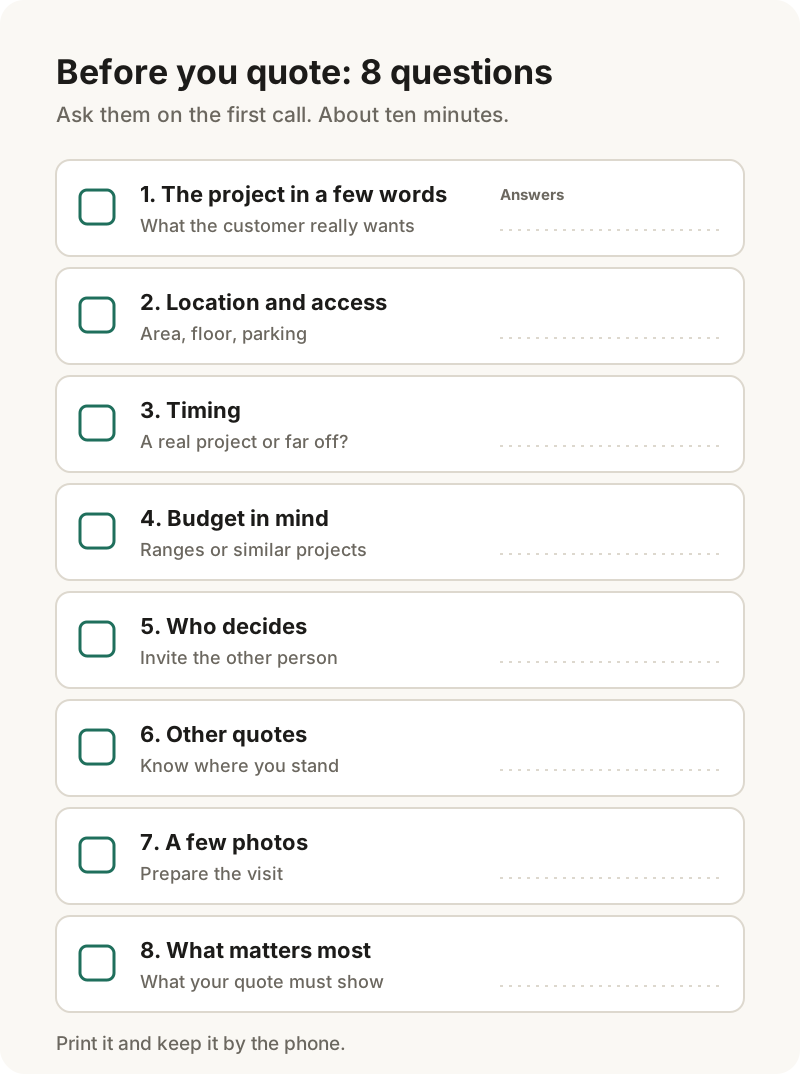
1. "Can you describe your project in a few words?"
Let the customer explain in their own words, before you get technical. You learn what they actually want, not just what they typed into the form. "Redo the bathroom" can mean new faucets, or stripping everything back to the walls.
2. "Where is the job, and how do we get in?"
The address, but also the floor, vehicle access, parking, whether there's an elevator. These details change the time on site and the price. They also tell you right away whether the job is in your area.
3. "When would you like the work done?"
Timing tells you whether the project is real or far off, and whether it fits your schedule. A customer who wants it "before Christmas" when you're booked until February deserves an honest answer now, not a quote in three weeks.
4. "What budget do you have in mind?"
The question everyone avoids, and often the most useful one. We come back to it just below, with three ways to ask it comfortably.
5. "Who else is involved in the decision?"
A spouse, a business partner, a landlord, a building manager, a parent who's paying. If someone else decides, you want to know before the visit, and invite them to be there.
6. "Have you asked for other quotes?"
It's not a nosy question: the customer has every right to compare, and they often do. The answer helps you position yourself. Someone comparing five companies on price alone wants something different from a customer who was referred to you.
7. "Could you send me a few photos?"
Two or three photos of the current setup can replace part of the visit. You prepare better, you spot problems early, and sometimes you can already give a price range.
8. "What matters most to you in this project?"
Price, timing, finish quality, a clean site, the warranty? This tells you what to emphasize in your quote, and what you'll be judged on. It's also the question that shows most clearly that you listened.
How to ask about budget without it being awkward
Plenty of tradespeople don't dare ask about budget. They worry about looking money-minded, or that the customer will inflate or shrink the answer. Yet most customers would rather talk about it early than discover a price that has nothing to do with what they expected.
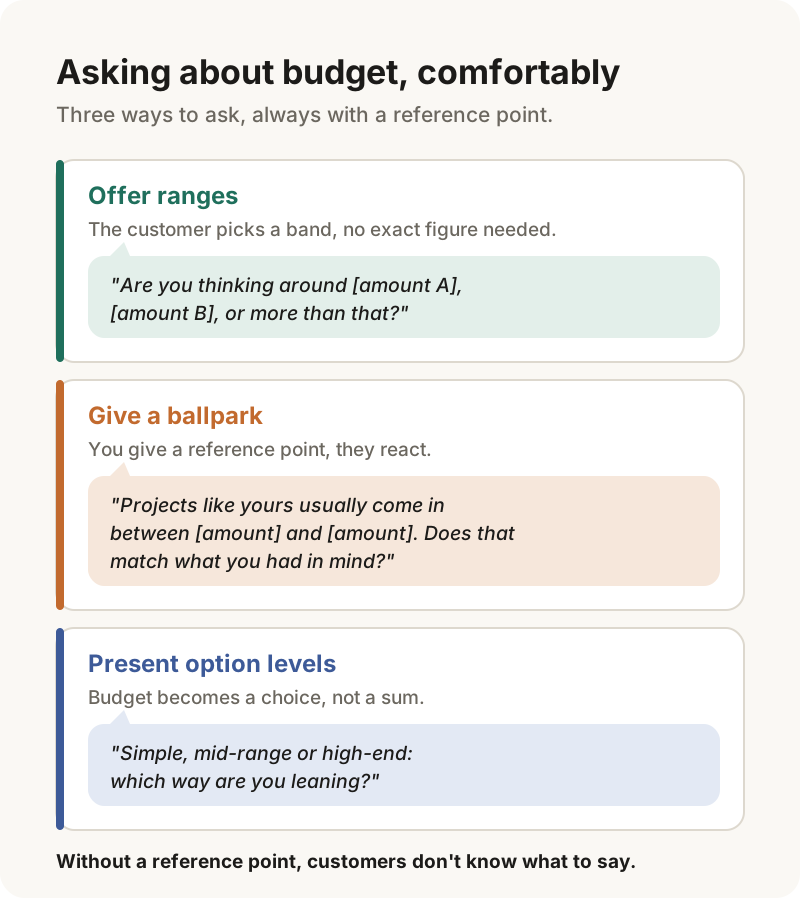
Three ways to ask:
Offer ranges. The customer doesn't have to name a figure, just pick a band.
"So I can suggest something that fits, are you thinking around [amount A], [amount B], or more than that?"
Give a ballpark from similar projects. You give a reference point, and the customer reacts.
"To give you an idea, projects like yours usually come in between [amount] and [amount], depending on finishes. Does that match what you had in mind?"
Present option levels. Budget becomes a choice of level rather than a sum.
"There are usually three ways to do this kind of job: a simple version, a mid-range one, and a high-end one. Which way are you leaning?"
Swap in your own reference prices. What matters is that the question comes with a reference point: without one, the customer doesn't know what to say.
And if they genuinely can't give a budget? Offer a quick phone estimate before you travel: "For this kind of job, allow between this and that. If that works for you, I'll come and measure up."
By phone or by form?
Some questions can be asked before the first call, in your website form or your acknowledgment message. Others work better out loud.
| Question | Form or message | On the phone |
|---|---|---|
| The project in a few words | Yes | To clarify |
| Location and access | Yes | To clarify |
| Timing | Yes, with options | To clarify |
| Photos | Yes | No |
| Budget | Yes, with ranges | Better out loud |
| Who decides | Not really | Yes |
| Other quotes | No | Yes |
| What matters most | Not really | Yes |
A simple rule: facts (where, what, when, photos) go in the form; questions that need trust (who decides, other quotes, what matters) are asked in person.
What to do with the answers: visit, estimate or decline
The answers aren't just for preparing the quote. They help you decide what happens next, before you put in half a day.
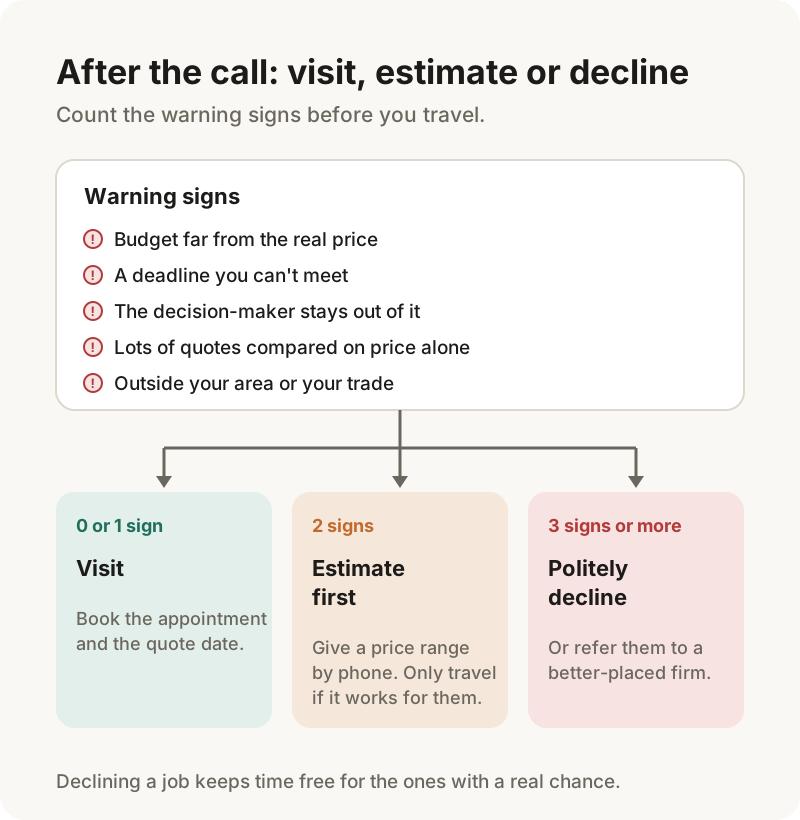
Look out for warning signs:
- a budget far from the real price, with no flexibility;
- a deadline you can't meet;
- someone who doesn't decide and won't involve the person who does;
- a customer comparing lots of quotes on price alone;
- a job outside your area or your trade.
Then:
- No warning signs, or just one: book the visit, and give the date for the quote.
- Two warning signs: give a price range over the phone first, and only travel if it works.
- Three or more: decline politely, or point them to another company better placed. You keep a good reputation, and you get your half-day back.
Declining a job isn't failure. It's what gives you time to do the quotes that have a real chance properly.
From the handbook: Discovery call questions that earn the next step, and how to end the call with a recap the customer confirms.
Key points
- The eight questions take ten minutes and prevent most wasted quotes.
- Ask about budget with a reference point: ranges, similar projects, or option levels.
- Decide what's next from the answers: visit, phone estimate, or a polite no.
Frequently asked questions
Should you ask for the customer's budget before quoting?
Yes. Without a range, you risk pricing a job that has nothing to do with what the customer can spend. Ask simply, by offering ranges or giving a ballpark for similar projects, so the question doesn't feel intrusive.
How many questions should you ask on the first call?
The eight questions in the checklist take about ten minutes. If the customer is short on time, focus on the project, the timing, the budget and who decides. Technical details can wait for the visit.
What if the customer won't give a budget?
Give them a ballpark for similar projects and ask whether it matches what they had in mind. If they still can't say, offer a quick estimate over the phone before you travel, rather than a detailed quote.