"We'll Think About It": What to Say So You Don't Lose the Job
"We'll think about it" almost always hides something else. What to say in the moment, what to send the same day, and how to keep the project alive until they decide.
 Julien DevoirCo-founder, Product & Systems
On this page
- Why "we'll think about it" is almost never the real answer
- What to say in the moment: a three-step script
- The three answers you'll hear most
- What to avoid
- The recap to send the same day
- While they think it over: stay present without pushing
- What "we'll think about it" looks like in your line of work
- When "we'll think about it" means no
- Key points
- Frequently asked questions
The meeting went well. You listened to the project, walked through your options, answered every question. The customer nods, smiles, then says it: "Great, we'll think about it."
You leave with no date, no idea what's holding them back, and a vague feeling that it was going well. Two weeks later, the project has quietly died.
Whether you're a wedding planner, a photographer, a sauna builder, a painter, a mover or a kitchen designer, you know this moment. The good news: you can prepare for it. Here's what "we'll think about it" really hides, what to say in the moment, what to send the same day, and how to stay present without pushing.
Why "we'll think about it" is almost never the real answer
Some customers genuinely need time. But most of the time, "we'll think about it" is a polite way of putting off a question they haven't asked. Behind it, there's almost always one of these:
- They need to talk to someone. A spouse, a business partner, the parents paying for the wedding, a committee that signs off on the budget.
- They have a doubt they haven't voiced. The price, an option, a date, a detail that worries them.
- They're comparing. Another vendor is sending a proposal next week.
- They're waiting on something. Financing, a confirmed venue, a moving date, the bank.
- They're missing information to decide. They don't know what happens next, or what's really included.
- They've already decided no. And they'd rather not say it to your face.
So in five cases out of six, there's something you can do. The only moment you can find out which one it is: right now, before you leave or hang up.
What to say in the moment: a three-step script
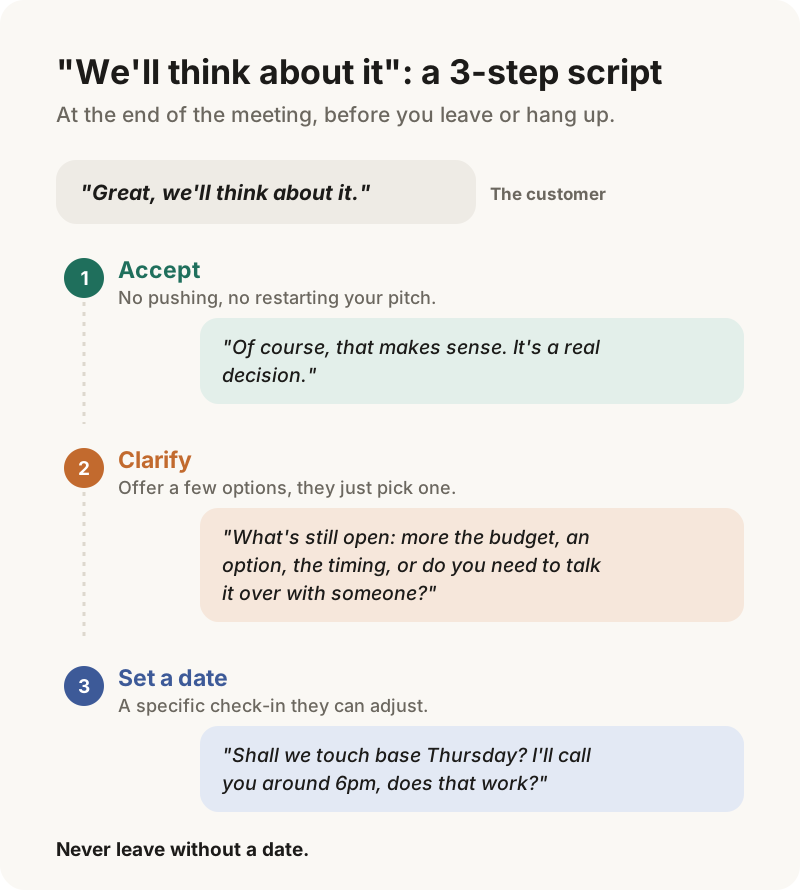
1. Accept
Don't try to convince them, don't restart your pitch. The customer needs to feel you respect their need to take time.
"Of course, that makes sense. It's a real decision."
2. Clarify
Ask what's left to decide. The trick: offer a few options, so they only have to pick one.
"So I can help you see it clearly, what's still open on your side: is it more the budget, a specific option, the timing, or do you need to talk it over with someone?"
The answer tells you exactly what to do next. And often, the customer realizes for themselves what's holding them back.
3. Set a date
Never leave without a check-in point. Suggest a specific date, and let them adjust it.
"How about we touch base Thursday at the end of the day? I'll call you around 6pm, does that work?"
A date isn't pressure. It turns "we'll see" into an appointment, and gives you a legitimate reason to call.
If the meeting is by phone or video, the script is the same. If the customer says "we'll think about it" by email, keep the three steps in writing: one line to accept, one question with a few options, one suggested date.
The three answers you'll hear most
The clarifying question usually brings out one of these three answers.
"I need to talk to [someone]." Offer to walk that person through the project too: a three-way call, a short video call, or a written recap they can simply forward. Decisions are rarely made well from a summary told from memory.
"It's the budget." Don't drop your price on the spot. Ask how big the gap is, then offer an adjusted version: fewer items, a simpler package, or doing it in two phases.
"We're waiting on other proposals." Fair enough. Offer to help them compare: "If it helps, I can send you a list of what to check in each proposal, so you're comparing the same thing." You become the one helping them decide, not the one waiting.
What to avoid
A few common reflexes do more harm than good:
- Fake urgency. "This price is only good today": if it isn't true, the customer can tell, and trust goes out the window.
- An instant discount. Cutting the price before you know what's blocking suggests the first price wasn't fair.
- "Call me whenever you're ready." The line that guarantees they won't. Nobody enjoys calling to say no, or even to say yes.
- Redoing the work for free, again and again. A third version of the plan, a fourth package, another mockup: without an agreed budget, every version adds work without bringing the decision any closer.
The recap to send the same day
That evening, or the next morning at the latest, send a short recap. It helps the customer think, it gives the person who wasn't there something to read, and it sets you apart from vendors who only send a price.
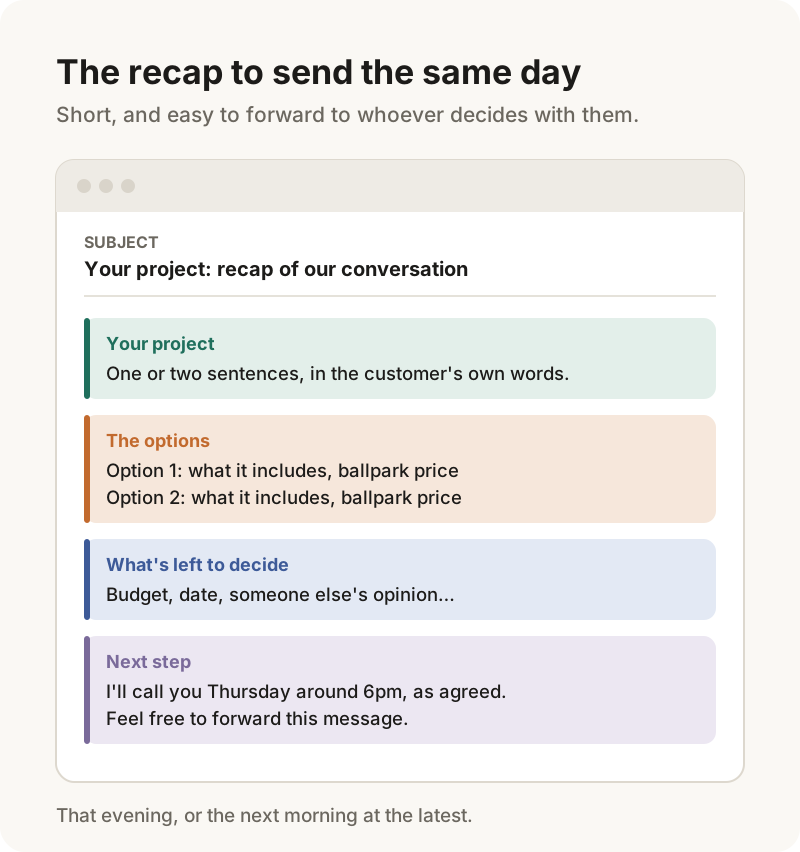
Subject: Your [project name] project: recap of our conversation
Hi [First name],
Thanks for your time today. Here's what I took away, to help you think it through.
Your project: [one or two sentences, in the customer's own words].
The options we discussed:
- [Option 1]: [what it includes, ballpark price]
- [Option 2]: [what it includes, ballpark price]
What's left to decide: [the point the customer raised, e.g. budget, date, someone else's opinion].
Next step: I'll call you [day] around [time], as agreed. In the meantime, feel free to forward this to [the person concerned] if that helps.
Have a good evening, [Signature]
Keep it short. The goal isn't to explain everything again, but to make the decision easier.
While they think it over: stay present without pushing
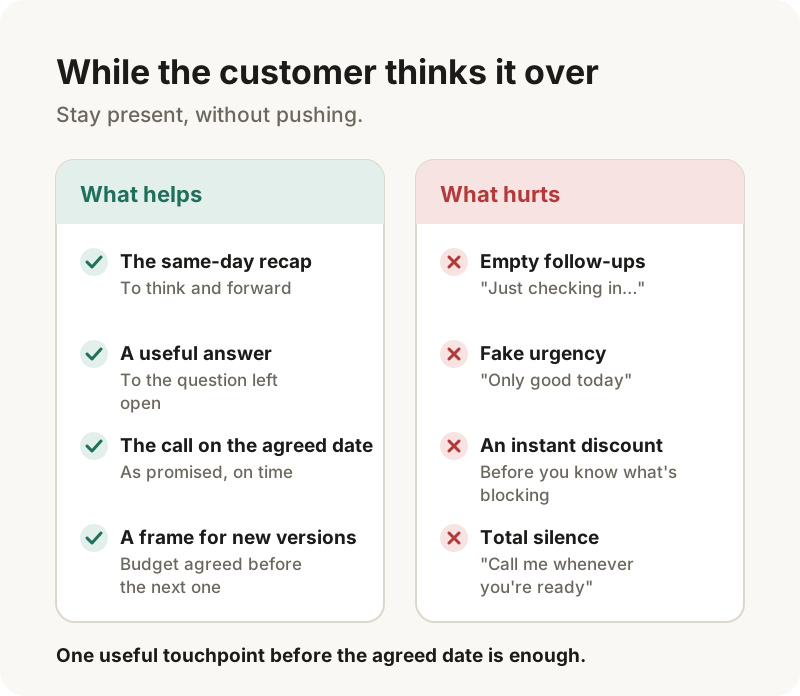
Between the meeting and the agreed date, one touchpoint is enough, as long as it brings something: an answer to the open question, a photo of a similar project, a detail about timing.
Hi [First name], about your question on [topic], I checked: [short answer]. Talk on [day] as planned.
On the agreed date, call when you said you would. If they don't pick up, leave a short voicemail and back it up with a text:
Hi [First name], I tried to reach you as planned about [project]. Where are you at in your thinking? If you're missing any information to decide, just let me know.
And if they ask for another version? Say yes, but set the frame: "I'll put that version together. So the next one is the right one, shall we agree on the budget first?"
What "we'll think about it" looks like in your line of work
The words are the same everywhere, but they don't always hide the same thing. A few examples:
| Business | When you hear it | What's often behind it | What helps |
|---|---|---|---|
| Wedding planner | After the first meeting | The venue isn't booked, or the families are chipping in | A recap that's easy to forward |
| Photographer | After sending packages | Comparing packages and vendors | Explaining the difference between packages |
| Sauna builder | After the proposal | The location, the budget, the spouse's opinion | Photos of similar installs |
| Painter | After the quote | A line-by-line comparison with another quote | Spelling out the prep work included |
| Mover | After the estimate | The moving date isn't set | Offering to hold a tentative date |
| Kitchen designer | After several plan versions | The budget was never agreed | Agreeing a budget before the next version |
| Landscaper | Late winter | The project is waiting for spring | Booking a start date |
If your business isn't on the list, ask yourself the same question: when do you hear it most often, and what are your customers waiting for at that point?
When "we'll think about it" means no
Sometimes the answer is simply no, and the customer doesn't want to say it. Signs: they dodge the clarifying question, won't agree to a date, go silent after the recap.
In that case, don't pile on follow-ups. After two or three useful attempts, send a closing message that leaves the door open, and ask for the main reason. An explained no beats silence: it helps you with the next projects.
Key points
- "We'll think about it" almost always hides a question nobody asked: the budget, an option, someone else, a comparison.
- In the moment: accept, clarify with a few options, and set a specific date.
- The same day, send a short recap the customer can forward to whoever decides with them.
Frequently asked questions
What should you say when a customer says "I'll think about it"?
Accept it first, without pushing: taking time is normal. Then ask what's left to figure out, offering a few options (the budget, a specific option, the timing, someone else's opinion). Finish by agreeing on a specific date to talk again.
How long should you give a customer to think it over?
As long as they tell you, as long as there's a date. For a small job, a few days is often enough. For a bigger project, allow one to two weeks, but always set a check-in point rather than waiting for them to come back on their own.
Should you offer a discount when a customer hesitates?
Not right away. A discount offered before you know what's holding them back suggests your price wasn't fair. Find the real reason for the hesitation first. If it's the budget, offer an adjusted option instead: fewer items, different materials, or doing the work in two phases.