"It's Too Expensive": What to Say Without Cutting Your Price
"Too expensive" doesn't always mean the same thing. The question to ask first, what to say in each case, and how to fit a budget without underselling your work.
 Julien DevoirCo-founder, Product & Systems
On this page
- Why cutting your price right away rarely works
- Too expensive compared to what?
- The question to ask first
- What to say in each case
- Options instead of a discount
- When to hold your price
- When to let the project go
- What clients compare, by business
- Prevent the objection before it comes up
- Key points
- Frequently asked questions
You put real time into the proposal. The project was clear, the client seemed sold. Then the message lands: "It's a bit more than we were expecting." Or, more bluntly: "It's too expensive."
The first reflex is to offer 10% off so you don't lose the job. It's usually a mistake. Not because you should never adapt, but because at this point you don't yet know what "too expensive" means.
Whether you're a photographer, a wedding planner, a sauna builder, a painter, a mover or a caterer, here's the question to ask first, what to say in each case, and how to fit a budget without underselling your work.
Why cutting your price right away rarely works
A discount given at the first "too expensive" has several effects, and few of them are good:
- It makes them doubt your first price. If you can knock off 10% in a minute, the client wonders what your quote was really worth.
- It opens the haggling. A first discount often invites a second.
- It cuts your margin, not your work. You'll do exactly the same job, for less.
- It may not fix the real problem. If the client is comparing two proposals that don't include the same things, 10% off won't change a thing.
Before you touch the price, understand the objection.
Too expensive compared to what?
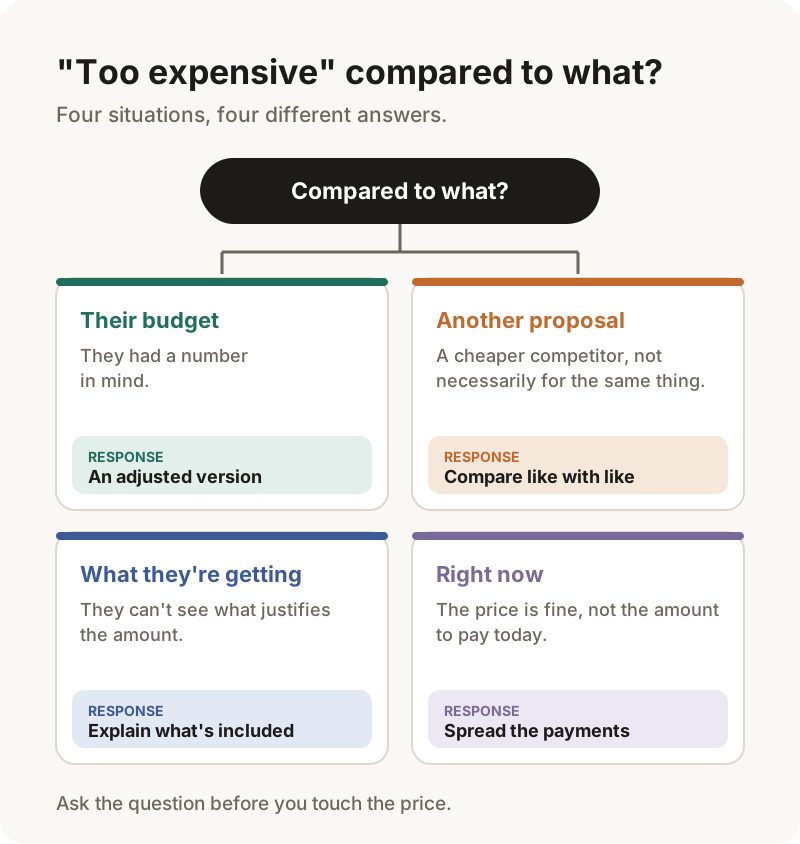
"It's too expensive" is almost always a comparison. The question is: with what? In most cases, it's one of these four:
- Compared to their budget. They had a number in mind, and your proposal is above it.
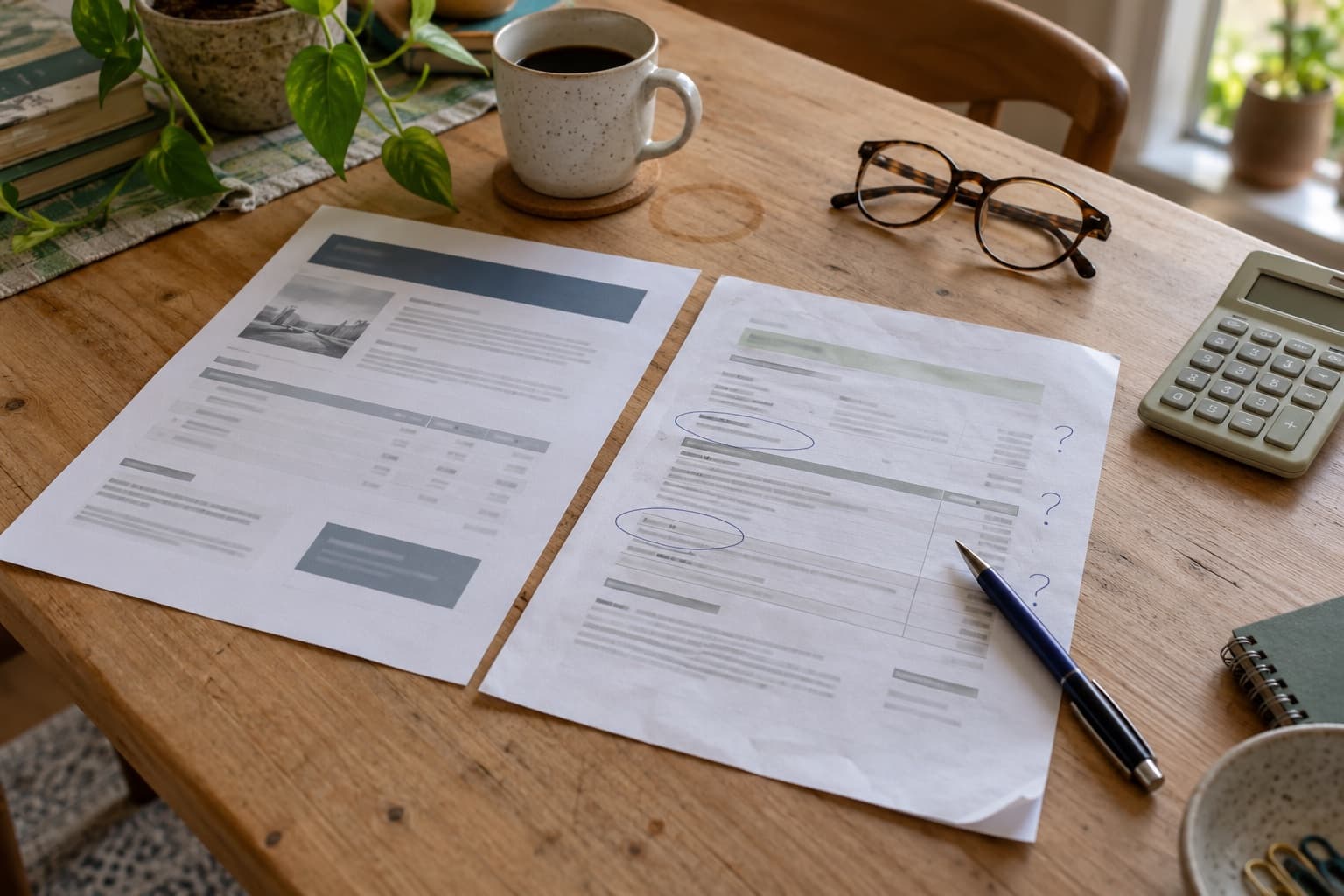
- Compared to another proposal. A competitor sent a lower price, not necessarily for the same thing.
- Compared to what they think they're getting. They can't see what justifies the amount: the work, the time, the quality, the warranty.
- Compared to right now. The price is fine, but not the amount they'd have to pay today.
And sometimes there's a fifth: "too expensive" is a polite way of saying no for another reason.
The question to ask first
Instead of defending your price or cutting it, ask a question. As with "we'll think about it", offer a few options so the client just has to pick one:
"I understand, thanks for being upfront. So I can see what I can do: is it more that it's above the budget you'd planned, higher than another proposal, or is there one part in particular that feels expensive?"
This question does two things. It shows you're taking the comment seriously, without getting defensive. And it tells you exactly which problem you need to solve.
What to say in each case
Above their planned budget
Ask for the number. Without it, you can't offer a version that fits.
"What amount did you have in mind? I'll look at what we can do within that, while keeping what matters most."
Then offer an adjusted version with less in it, rather than the same project at a lower price. The client chooses what to keep.
Higher than another proposal
Never knock the competitor. Help the client compare like with like instead.
"It makes sense to compare. To make sure you're comparing the same thing, we can look together at what each proposal includes: the time involved, what's supplied, the warranties, what's extra."
Often the gap comes down to a difference in scope: fewer hours, less durable equipment, prep work left out, add-on fees. The client can't see it until someone shows them.
They can't see what they're paying for
The problem isn't the price, it's understanding. Spell out what's included, and above all what they get at the end.
"I may have sent you something too technical. Let me take five minutes to walk you through it: what's included, how much time it represents, and what you'll have at the end."
Not the right time to pay
The price isn't the issue, cash flow is. Offer to spread the effort: a smaller deposit, a payment plan, or doing it in two phases.
"If it's mostly about the amount up front, we can structure payment differently: [in installments / in two phases]. Would that help?"
Options instead of a discount
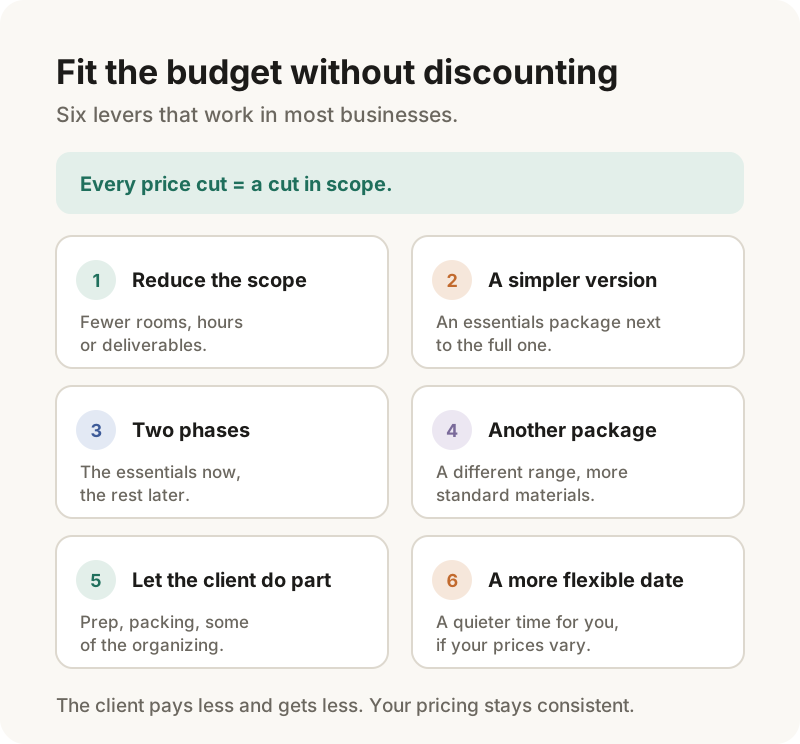
When the budget really is the problem, the rule is simple: every price cut should match a cut in scope. The client pays less and gets less. Your pricing stays consistent.
A few levers that work in most businesses:
- Reduce the scope. Fewer rooms, fewer hours on site, fewer deliverables.
- Offer a simpler version. An essentials package next to the full one.
- Do it in two phases. The essentials now, the rest later.
- Change the equipment or package. A different range, more standard materials.
- Let the client handle part of it. Prep, packing, part of the organizing.
- Pick a more flexible date. A quieter time for you, if your prices vary by season.
When to hold your price
Sometimes the right answer is to change nothing. Your price reflects your work, and the client should be able to hear that.
"I understand it's more than you pictured. This price covers [what's included]. I'd rather be upfront than offer a price I couldn't stand behind. If you'd like, I can put together a simpler version."
Holding your price isn't arrogance. It shows the number wasn't picked out of thin air. Many clients respect a vendor who explains their price more than one who drops it at the first sign of hesitation.
When to let the project go
If the gap is huge and no adjusted version fits the budget, say so honestly.
"For this budget, I won't be able to deliver a result you'd be happy with, and I'd rather tell you now. If your budget changes, or you'd like a simpler version down the road, I'd be glad to talk again."
The client keeps a good impression of you, and the door stays open. A project lost honestly sometimes comes back, or turns into a referral.
What clients compare, by business
"Too expensive" often comes from what the client can't see in the proposal. A few examples:
| Business | What clients often compare | What to make visible |
|---|---|---|
| Photographer | The day rate | Number of photos delivered, editing, delivery time |
| Wedding planner | Another planner's package | Coordination hours, day-of presence, number of vendors managed |
| Sauna builder | The price of a kit sold online | Installation, electrical hookup, warranty, after-sales service |
| Painter | Price per square foot | Surface prep, number of coats, protecting the space |
| Mover | The total price | Number of movers, packing, insurance, disassembly |
| Caterer | Price per guest | Service staff, tableware, setup |
| Landscaper | The price of the plants | Plant warranty, soil prep, maintenance |
Prevent the objection before it comes up
The best answer to "too expensive" is not hearing it at all. Three habits cut this objection down a lot:
- Talk budget before you price. A range, even a rough one, stops you sending an out-of-budget proposal.
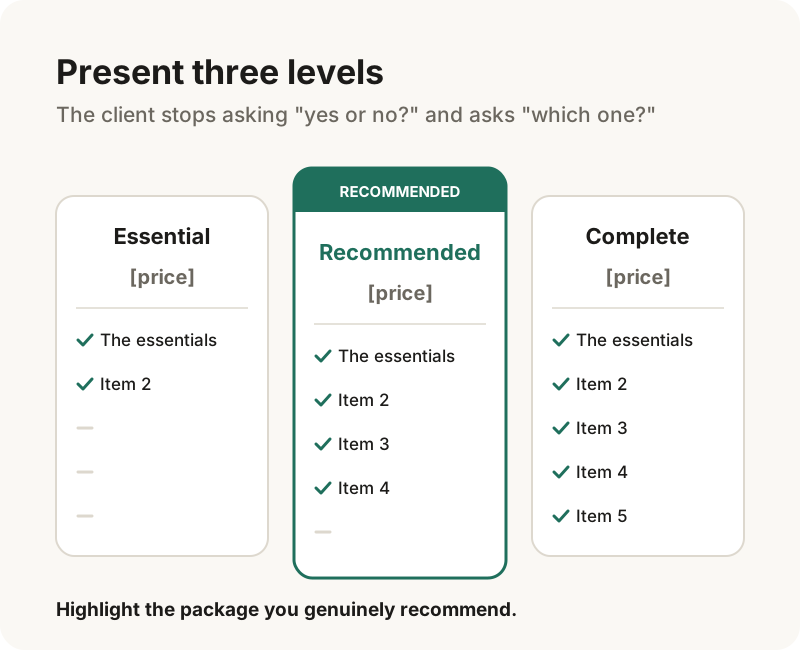
- Present several levels. Instead of one take-it-or-leave-it price, offer two or three packages. The client stops asking "yes or no?" and starts asking "which one?"
- Walk them through the proposal instead of just sending it. A quote read without explanation boils down to a number at the bottom of the page.
Key points
- "Too expensive" is a comparison. Ask first: compared to the budget, another proposal, what's included, or the timing?
- Avoid discounts with nothing in return: every price cut should match a cut in scope.
- Prevent the objection by talking budget early and presenting several package levels.
Frequently asked questions
What should you say when a client says "it's too expensive"?
Start by understanding: too expensive compared to what? Their planned budget, another proposal, what they think they're getting, or too much right now? Each answer calls for a different fix: an adjusted version, a side-by-side comparison, an explanation of what's included, or a payment plan.
Should you give a discount when a client says your quote is too expensive?
Avoid discounts with nothing in return. They suggest your first price wasn't fair and invite more haggling. Offer an adjusted option instead: fewer items, a simpler package, or doing the work in two phases. That way, every price cut matches a cut in scope.
How do you stop clients from finding your quotes too expensive?
Talk budget before you price, present several package levels instead of a single number, and walk clients through your proposal instead of just sending it. A client who understands what they're paying for pushes back on price far less.